
And God said: « Let us make man in our image » (The Bible – Genesis 1:26)
Translation note:
This article is translated from french.
The french term laïcité is always translated in english with the word « secularism ». This is not correct, as we have in french the word « secularism ». It is true that there is some secularism in laïcité. But Laïcité is more than a philosophie, it is the religion of the french républic. We will keep this french word laïcité = laïcity nearly untranslated.
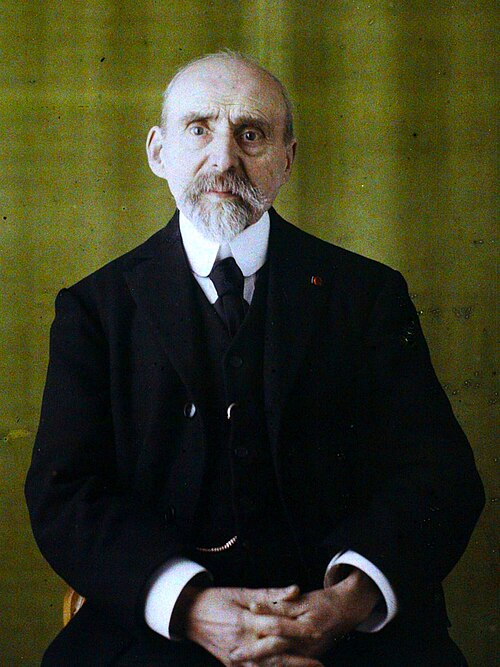
If Ferdinand Buisson was alive, he would reply to God:
The republican man is a religious animal.
Ferdinant Buisson
Introduction
About twenty years ago, I was asked questions regarding laïcity – the state religion – within an Indonesian Christian community. I was surprised that ecumenism and a certain form of laïcity were better received than the reminder of certain biblical truths concerning the uniqueness of the Way in Christ. But this apparent « neutrality » which everyone saw as a safeguard ensuring religious peace, has not borne only good fruit: Today1 radical Islamists2 hold key positions in school and university education and have indoctrinated the population over the last decades. 9 per cent of the population supports Daesh3.
In France, voices are being raised against :
… an increasingly intolerant face of a form of laïcity that seeks to ignore the very existence of any religion. René Chiche, a senior lecturer in philosophy and author of the book *La désinstruction nationale*, … protests:
« We have a serious problem with culture, French identity, language and thought itself. … if we do not understand its religious roots. »4
It is clear that laïcity5 has also enabled Protestant minorities to escape a rigid Catholic straitjacket that denied them the right to marriage and burial. This article will focus solely on the religious and militant aspect of laïcity, which insidiously propagates the rejection of Judeo-Christian values, replacing them with a republican religion.
The freedom of Christians and the teaching of their faith, or of the history that bears witness to it, are being called into question. Will our Bible soon have to be rewritten, as in China6 ? A form of « republican » persecution7 » rears its head whenever scathing criticism of Islam disturbs our laïc society too much.
Geneva laïc Exhibition: God(s) – User Guides
The simple man believes everything he is told, but the prudent man watches his step. (Proverbs 14:15)
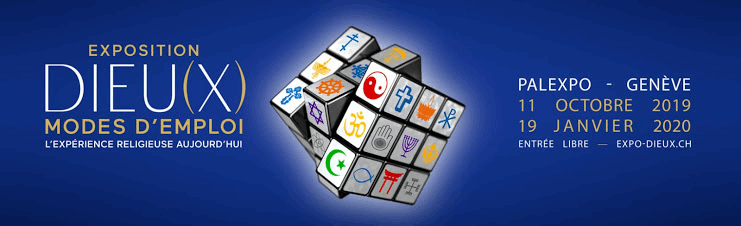
This major laïc exhibition has already been shown in Paris, Madrid and Quebec. 35,000 people visited it in Geneva. Its take on « religious facts » struck a chord with us. It has a somewhat sarcastic tone:
The gods are coming to Geneva :
Calvin’s city is hosting the exhibition: God(s), User Guides, a journey through contemporary religious practices. Based on an original concept developed by Tempora and endorsed by an international scientific committee chaired by the historian Elie Barnavi, the exhibition has been specially adapted for Geneva…
An exhibition on religions that deals neither with theology nor history. … it presents the religious experience in all its universality (its questions) and particular aspects (its diverse practices), approaching religion from a laïc perspective through a thematic framework (Deities, Places, the Afterlife…).8
Whilst seeking to find out more about this international laïc exhibition, we realised that it works with museums, schools and universities to convey a laïc outlook to young people. We also analysed the accuracy of laïc teaching materials on religions. As it deals neither with theology nor with the history of religions, we are surprised that » a scientific committee » could have given it any kind of endorsement.
The television interview with the exhibition organisers
An interview on Swiss Romandy television9 features the organisers of this exhibition, or those who actively contributed to it, such as Isabelle Benoit: curator of this exhibition; Isabelle Graesslé, a « pastor », director of the Geneva Museum of the Reformation; Antony Ardiri, a history teacher at a Geneva lower secondary school, who contributed to a booklet accompanying the exhibition for the history course; and Sarah Scholl, senior lecturer at the Faculty of Theology at the University of Geneva.
Isabelle Benoit:
« What we want to convey to young people is that they are called upon to live in multicultural societies10. In this context, it is important that, even if they do not hold any religious beliefs11 they should acquire information and knowledge about religion so that they can make sense of a number of phenomena.
In Europe, we may be living in societies that are increasingly secularised, but this is not the case elsewhere.
A very large proportion of humanity views the world through religious lenses; these religious lenses are very numerous and, above all, they are the ones that guide the daily actions and decisions of a large proportion of humankind…
Europe, which itself did not invent any of the major religions, is today the true melting pot of the world’s religions.
Religious peace , contrary to what we might have imagined, is never a given, and we must always continue to defend it; these young people must be the daily builders and architects of this religious peace. »
Is Judeo-Christianity a religion » invented » by humankind, or is it the manifestation of the God who created us (Gen 1:1) and chose us (Isaiah 41 :8; Ezekiel 20:5; Acts 9:15), and who ultimately came (Matthew 5:17; John 12:47) to humankind?
The laïcity of our secularised Europe, to which Ms Benoit lays claim, is itself a laïc religion with its own perspectives, its « logo », its rites and its prestigious buildings. And this religion was indeed invented in Europe.
Journalist: What do you hope to convey through this exhibition? Isabelle Graesslé replies:
We explore different moments and perspectives to show that there are more things that unite people than divide them. This is a step forward compared to all the » rumours » surrounding religion.
» It is true » that there are commonalities across all religions :
- their gods are created by man, (2 Kings 19:17–18)
- their gods are powerless to help, and do not save. (Ps 115:4-8 )
The one true religion : The desire to unite the peoples of the world remains as relevant as ever, but to what end, and under what banner ? This was also the desire of the « sons of men » after the Flood : This human endeavour was also the perfect example of a religion—a collective endeavour—that enables one to reach heaven.
They said to one one to another: « Come, let us make bricks and bake them thoroughly. » And they used brick instead of stone, and bitumen instead of mortar. They said, « Come, let us build ourselves a city and a tower whose top reaches to the heavens, and let us make a name for ourselves, lest we be scattered over the face of the whole earth. (Genesis 11:3–4 ).
God did not allow man to supplant the one Name (Isaiah 63:12, 14; Jeremiah 32:20, etc.) to which man was to give glory (Genesis 1:26;; Mark 12:17).
Not to us, O Lord! Not to us, but to your name be the glory, for the sake of your goodness, for the sake of your faithfulness. (Psalm 115:1 )
We are still today in this state of dispersion « across the face of the whole earth » (Genesis 11:8–9), and nothing will change this until his return takes us by surprise. (Luke 21:35)
However, several passages in Scripture recount historical events (past, present and future), such as the exodus of the people from Egypt and the return of His people to Israel, which demonstrate the unique nature of the Lord.
… the Lord is greater than all the gods; for even in the very things in which they acted presumptuously, He was above them. (Exodus 18:11 )
Antony Ardiri replies:
We do preparatory work before the exhibition, and we revisit in class any questions the pupils may have had. The booklet is designed to be studied as part of history lessons, but the exhibition does not really deal with history; pupils may raise various questions through this historical approach, questions which are then explored further in class with teachers who are trained to deal with the various questions pupils may ask.
Teachers must first be « taught » themselves, in order to respond to pupils through the « religious » lens of laïcity presented here. This approach in Switzerland is entirely consistent with laïc methods in France.
Both children and teachers are therefore taught (indoctrinated)12 in three stages: before, during and after the visit.
It is alarming to note that the historical truth about religions is omitted from school textbooks. The journalist expresses this skilfully in the following question:
There is no genuinely historical perspective intentionally omitted from this presentation; what does it enable us to understand and learn about religions?
The question is legitimate, and no one disputes this assertion, which is key to understanding the spirit of laïcity. Sarah Scholl replies:
It allows us to get to the heart of the religious question /the religious phenomenon – it is what people experience. We hear people express what religion means to them, and that is truly valuable; it enables us to address the issue by looking at what people experience and supplementing this with history and something more factual, etc.
The religious question is presented here as a social and anthropological phenomenon. The criterion of « truth » is therefore not part of the exhibition; it will have to be supplemented later with « etc. »
the religious experience as lived: What matters is oneself… the factual and historical reality, if presented only in part, serves merely to fill in the gaps in the backdrop. The journalist confirms this:
We are at the heart of the experience in fact
The Word of God warns us against the « thoughts of our hearts »
To the chief musician. A psalm of David. The fool says in his heart: « There is no God! » They have become corrupt; they have committed abominable deeds; there is none who does good. Psalm 14:1
There is a way that seems right to a man, but its end is the way of death. (Prov 14:12 )
What is presented, therefore, is a human perspective on religions, rather than the religions themselves, which we wished to understand better. In short, it is this religion or worldview (laïcity) that takes centre stage.
Of course, the experiential aspect of religions can be a rewarding subject for scientific study, but it must not obscure a historical and factual reality. God acts amongst humankind, and warns us against invisible and deceptive forces. The journalist highlights the taboo nature of religions:
« It is said that there are two subjects—we must not discuss with our friends and family—namely politics and religion, so why should we talk about religion in class with the pupils? »
The school does not allow its founding republican values to be called into question ; in particular its « religions » : Freemasonry and laïcity.
Antony replies:
« One of the School’s aims is to develop pupils » critical thinking; at school, there are no taboos, whether political or religious; we tackle all these issues and debates with the pupils so that they can engage with and understand the world »
Developing our critical thinking is what we aim to do, as the Word of God encourages us to do, cf. Proverbs 1:1–7; 14: 15 ; Acts 17:29 . We shall see later that an « understanding of the world » devoid of historical truth is nothing more than misleading propaganda.
Isabelle replies: « Getting to know oneself better, in order to understand others – that is what is happening today in this Genevan microcosm.13 «
This is a fundamental assumption of laïcity: getting to know others » religions better will enable us to live together more harmoniously. This is a mistake; Shia Muslims are particularly adept at promoting their religion – or rather, only what they wish to reveal. She continues :
I believe this is one of the key reasons why both the previous and current Geneva City Councils supported and sought to host this exhibition in Geneva in particular, in line with the New Law on laïcity, which is not about obscuring or glossing over beliefs, faiths, denominations and religions , but to discuss them, but whilst maintaining the laïc aspect in public life.
This was the vision of Agrippa, a political figure who was a contemporary of Paul. Everyone has their own religion, and this is not called into question.
they had discussions with him regarding their particular religion, and about a certain Jesus who had died, and whom Paul claimed was alive. (Acts 25:19)
He neither confirms nor denies the resurrection, but distances himself from it as though it concerned only some strange, barbaric beliefs. But Paul does not stop there; he recounts his story and his encounter with the Messiah :
And Agrippa said to Paul: « You are about to persuade me to become a Christian! » (Acts 26:28)
Is God plural or one?
If a wise man argues with a fool, whether he gets angry or laughs, there will be no peace. Proverbs 29:9
Yes, man is plural, distinct and separate from God, but God is one! The aim of this man-made religion, like the Tower of Babel, is to restore unity to humanity. Man cannot become « one », and even if he could, he would remain separate and distinct from God, in sin.
Now a mediator is not a mediator of one alone, but God is one. Gal 3:20
To accept and value all religions is to strip them of the truths of the object of their quest: toreach God. It is to place Man at the centre in God’s stead and to erase the reality of a living God.
Even if religions are mistaken, in that no religion enables us to reach the god or gods it invents, God nevertheless exists, and He is our Creator, who has come to us: Emmanuel.
The journalist continues :
In Geneva’s recent history, religion has not been taught as such in schools; why has it come to the point where it is now deemed necessary?
Response from Sarah Scholl
In Geneva, we have an almost caricatural example of the division of roles dating back to the 18th century, where the churches were left to take charge of religious instruction using a traditional catechism, whilst the school system remained completely uninvolved. It’s slightly different in the other cantons, but ultimately the timeline is the same.
With the exception of the 1990s and 2000s, when this [religious] diversity exploded in our cities14 and our countryside, the need to change the way we talk about religion became important, as is the case in Geneva, where this shift is introduced through the history curriculum, but it is also the case in the other French-speaking cantons: we move away from the realm of catechism and biblical teaching to focus on lessons on « religion as a social phenomenon ».
A dead faith has nothing to bear witness to in the face of other dead religions. The choice has therefore been made not to bear witness to Christ before those who do not know him. The expression « religious phenomenon » claims to be factual, but this is precisely what is lacking in this course. The emphasis is on the works of man seeking God, rather than on those of men sent by God and their history amongst mankind. James offers us a sarcastic view on the « truth » of religion:
If anyone thinks they are religious, yet fails to keep a tight rein on their tongue but deceives their own heart, that person’s religion is worthless. Pure and undefiled religion in the sight of God our Father consists in visiting orphans and widows in their distress, and keeping oneself unstained by the world. (James 1:27)
In short, the » religion » that pleases God is an act of compassion towards the weak and has nothing to do with purely and simply » religious » rites. That which is religious in the literal sense is implicitly impure and tainted. The word of God dares to judge with sarcasm, including its own » flock » (Exodus 20 :28).
laïcity is adept at « vulgarising » other religions in order to replace them, but the Word of God reaches its pinnacle in the resurrection of Christ, a true, factual and unrivalled event.
Paul sees in his religious past as a Pharisee a righteous hope, but one whose meaning and fulfilment lie solely in faith in the resurrection.
They have long known, if they care to admit it, that I lived as a Pharisee, according to the strictest sect of our religion. (Acts 26:5 )
We look at the manner of prayer and the rites of the faithful, but not at the words and deeds of the founder of this or that religion. The word of God teaches us discernment and how to take a stand.
When what the prophet says does not come to pass and does not happen, it is a word that the Lord has not spoken. The prophet has spoken it presumptuously; do not be afraid of him. ( Deuteronomy 18:22 )
Journalist :How should we deal with religious diversity in the classroom ?
Antony Ardiri replies:
When we tackle the subject of religion, we must consider the terms we use: the definition of the term « religion » is, after all, rather complex; there is also a history behind it, which is not universally accepted, or which is not perceived in the same way everywhere. The validity of that history therefore depends on the acceptance of the person hears it!
Strange words from a history teacher! Postmodernism has taken precedence over the the teaching of history. It reminds me of a female pastor from the Protestant Church of Geneva who said that a translation of the Bible must be adapted to our times, and that it is a matter of personal feeling. She had nothing against the New World Translation of the Jehovah’s Witnesses.
Ongoing exhibitions
In Switzerland, in November 2019, a similar mini-exhibition based on the 2012–2013 interfaith calendar published by Enbiro in Lausanne in collaboration with the Interfaith Platform was presented at the EPFL in Lausanne.
« The process of modernisation in societies leads to a separation of politics from religion »
… has its own logo: a series of six concentric circles. This new religion aims to unify all others at its centre.
The flagship building of this laïcity is the Louvre Pyramid.
Its monument: The Louvre Pyramid 15
Originally a royal palace converted into a museum during the French Revolution, the Louvre underwent a major renovation programme in the early 1980s. Its glass pyramid, flanked by triangular water basins, is intended to symbolise a harmonious blend of the old and the new. Inaugurated in 1989, it houses the museum’s entrance hall, and visitor numbers have since risen from 3 million to 12 million in 2012.
In Western Europe, from the end of the Middle Ages, and subsequently during the process of modernisation of societies which led to the separation of politics from religion, architectural art served primarily the buildings of civil power (e.g. executive, legislative and judicial branches), which are the bastions of democracy. Very often, their style is intended to symbolise a shared history and common values, as exemplified by the Capitol in Washington (United States) or the European Parliament in Strasbourg (France). The same symbolic aim has prevailed for civil buildings with an international purpose, such as the United Nations Headquarters in New York or the Palais des Nations in Geneva.
This separation of politics and religion amounts to the exclusion of God and His commandments from human life. This is evident even in the details: dates are written as 2500 BC; the calendar remains Christian, yet no mention is made of Christ. That said, even those who oppose Judeo-Christianity very often adopt its symbols.
The play « At the beginning »
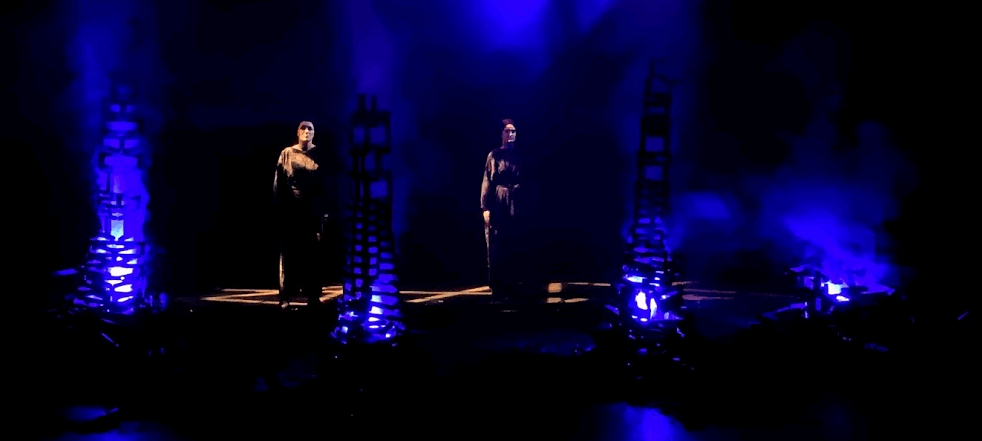
During the same exhibition in Geneva, a play was performed by two actresses. The play was written by Philippe Blasband16 ; born in Tehran, this French-speaking filmmaker and writer is of Jewish origin. It is is certainly no coincidence that the chosen title refers to the first word of the Bible (בראשׁית; cf. Genesis 1:1), which is also the name of the first book of the Bible in Hebrew.
All the scenes recount the experiences of people caught up in religious wars, at different periods, either as soldiers or fanatics, or as victims. The cries and lamentations were moving and almost frightening17. The scenes refer to various religious wars :
– In 630, the early days of Islam, on the Arabian Peninsula
– In 1904, during the Russo-Japanese War
– In 1099, in Jerusalem, during the Crusades
– In 1502, witch trials
– In 2002, in Jerusalem, a suicide bombing
– In 1681, in Mougeon, France, the Dragonades
– In 167 BC, the Jewish revolt of the Maccabees
– In 2006, reference to the wars in the former Yugoslavia
The impression one is left with is that religions lead only to massacres. This play seems to blame the God of « The Beginning » for all the crimes on earth. The conclusion of this play was read out in its introduction:
« … Depending on the era, people have drawn from the same texts reasons to slaughter their neighbour, or to live in harmony with them. Peace or war, persecution or brotherhood, exclusion or tolerance: religion—all religions, permits everything, justifies everything… The Christian West has provided its answer… It is called laïcity. Is this the only possible solution? Undoubtedly… « 18
These are classic views and arguments of atheism. Let us recall that it was during Europe’s secular and laicist era that two wars took place on such a vast scale that they were termed « world wars » for the first time in history. The Russian and Chinese revolutions, although they had cast God into the dustbin, were also among the deadliest. The God of the Bible reminds us precisely that in the beginning:
- Death came into the world through one man, because of disobedience in Eden. (Genesis 3:3)
- The first murder was purely an act of jealousy, and God had warned Cain. (Genesis 4:8)
- Murder comes from the heart … (Matthew 15:19)
- One of the Ten Commandments is « Thou shalt not kill ».
The first of the scenes: A single actress speaks as an unborn child, still in her mother’s womb, who is soon to be killed along with her mother by a soldier’s sword. Neither the place nor the date is known. But no scene in this play is devoted to murder by planned abortion.
Abortion covers the earth with murder (Isaiah 26:20–21):
3, 6 million children are aborted every month19. That is 125,000 a day, the most common form of murder practised by the » inhabitants of the earth « . It is estimated that 8 billion children have been aborted.
Paradoxically, the laïc republic did encourage and protect abortion and the world despises Christians who assert that killing an unborn child is murder, just like killing one’s father or mother, yet the world blames believers (and indirectly God) for religious wars.
Like many before him, the author demeans the Creator God20 (Exodus 15:11; 18:11;; Psalms 96:5) to a mythical god among many others ( 2 Kings 19:12–13 ; 2 Chronicles 32:17 ; Isaiah 36: 18–19), made by human hands (Acts 19:26).
« World » peace » and worldly peace is not on the horizon (Rev 6:4). Only the Prince of Peace (Isaiah 9:5; Luke 1:78–79) can give us His Peace (John 14:27) and bring it about (Rev 22:5).
The mind behind the exhibition : Élie Barnavi
The scientific direction and part of the editing of the exhibition catalogue are being carried out by the former Israeli ambassador to France: Élie Barnavi.
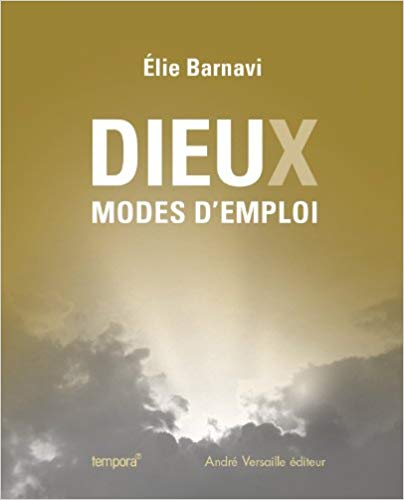
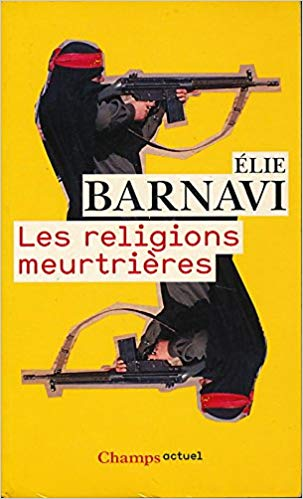
He is also the author of the essay » Les religions meurtrières « 21; His publisher describes it as follows :
A professor of modern Western history at Tel Aviv University, Élie Barnavi served as Israel’s ambassador to France from 2000 to 2002. He currently chairs the scientific committee of the Museum of Europe in Brussels.
He had previously edited a book entitled » DIEUX modes d » « emploi « 22 and organised a similar exhibition in Paris in 2012.
We shall comment on his worldview, which sets the tone for this exhibition, by quoting an extract from his book » Les religions meurtrières « :
Every religion is political: religion, any religion, remains first and foremost a matter of the group, that is to say, of power… Depending on the spirit of the times—that is, the social and cultural conditions that shape the dominant ideology—these walls are more or less high, more or less impenetrable, more or less porous. But they have always existed and will forever ; they will only fall when everyone has seen the light. Every revealed religion is a religion of struggle ; only the weapons change, and the zeal with which they are wielded.
… And so, after centuries of intertwining, Church and State have finally parted ways. The brutality of this process has given French laïcity a distinctive character, which you French people like to believe is universal. It is not. For the process of separation did not take place everywhere in the same way, nor at the same pace. Clearly, the dividing line is the Reformation. Where Luther, Calvin and their followers succeeded in gaining a foothold and establishing their version of Christianity—tearing down, in the process, the old edifice of the Catholic, Apostolic and Roman Church—the separation of Church and State was able to take place in harmony, without drama or rupture. Why? Well, because the Reformation itself accomplished the work of secularisation that lay at the heart of political modernity.
Barnavi is certainly a highly erudite thinker, and almost all the information in his books appears to be factual. But the central thread of his argument and his conclusion are not. The author overlooks, for example, that:
- Judeo-Christianity is revealed, yes, but it is not a revealed religion. For it is not a religion in the strict sense. A religion is created by humankind according to its own choices. The God of the Bible is not created, but He created humankind, and chose His people and His elect. God came to us, and we cannot go to Him by virtue of any sacred service.
- We cannot lump all » revelations « —both true and false—together. That would be to deny history and scorn the truth. It is a pity that the author has not recognised the hand of God at work amongst his people for four millennia (or has he actively opposed it?).
- It is the Freemasons, the driving forces behind laïcity, who were also the driving forces behind the sexual revolution and abortion23.
The subject of deadly religious wars is not an easy one to tackle, as any political party with a worldview, a goal and an ideal is quasi-religious. The Nazi Party (NSDAP24) was born out of the Thule Society25, a secret, esoteric society based in Munich with its own myths and beliefs. The introduction on the French Wikipedia page attributes the Thule Society primarily to conspiracy theories(!), unlike the English Wikipedia page.
In the 1990s, the Dachau Concentration Camp Memorial Site (near Munich) featured the Thule Society as the first exhibit in its tour, to explain the origins of Nazism. Its members, listed in the museum’s catalogue entry26, were all influential figures in the Nazi Party. And all those who survived the war were sentenced to death by hanging in 1946. (See Esther 8:7, 9:10).
Marxism, too, is an anti-Christian ideology steeped in occultism. Marx and Engels27 discussed the details of Christian activities in the Elberfeld region, as if they were running an evangelical news blog !
This region is still strongly Pietist and distinguished itself during the Second World War as one of the places where genuine Christians resisted Nazism.
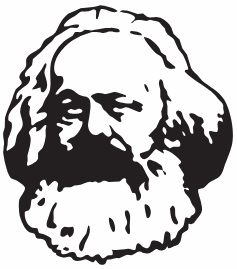
Marx wanted to deliver a « final blow » to God28 and drive him from heaven.
The Age of Enlightenment: a dark light29
… If, then, the light within you is darkness, how great is that darkness! (Matt 6:23)
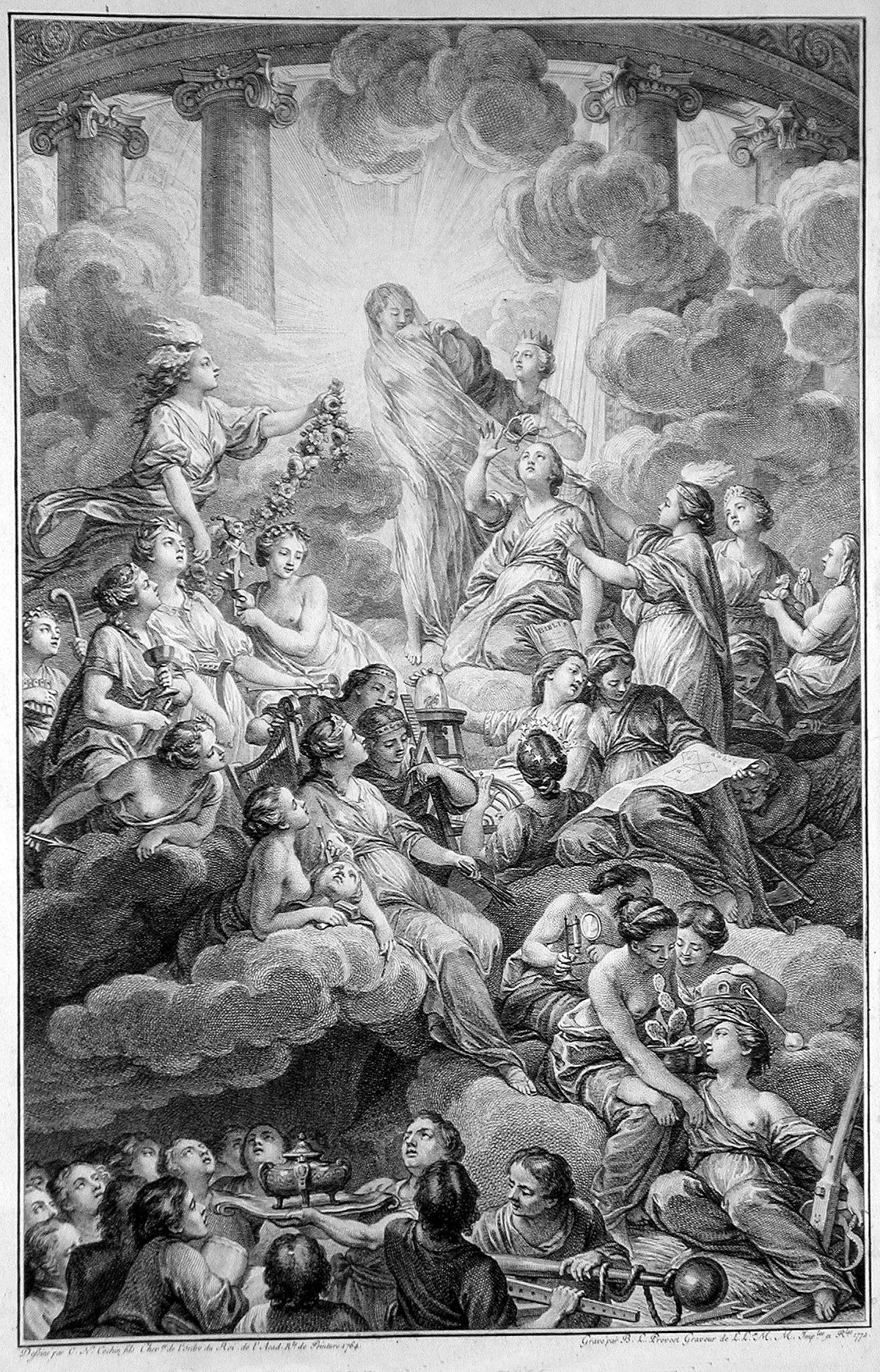
Eli Barnavi thus refers to the Age of Enlightenment in this catalogue:
This is undoubtedly where the problem lies in the West. Fragmented and centred on the individual and their inalienable rights, liberal society, in the classical sense of the term, has lost its sense of the sacred – and I mean the sacred, not the religious. Human rights remain the most precious legacy of the Enlightenment, but they cannot on their own form the basis of a community. … the men of [17]89 struggled so hard to create stable institutions on its ruins. Hence the need for a civil religion, the ingredients of which we know: human rights, of course, but also history, the sovereign nation, the Constitution, and the Republic.
The frontispiece of Diderot and d »Alembert’s Encyclopédie. Quite rightly, it depicts a contemporary reality: » civil religion » » is the new light. For us Christians, light does not exist without creation (Genesis 1:3) . God is our light (cf. 2 Samuel 22:29) . John begins his Gospel with « In the beginning » and describes Christ as the Creator, the Life and …
This was the true light, which, coming into the world, enlightens every person. It was in the world, and the world was made through it, yet the world did not recognise it. (John 1:9–10)
The light of laïcity is like that of a prism, which obscures the one true source. The massacres of the last century serve as a reminder of the unchanging nature of humankind, just as in the case of the first murder, when man, in his contempt for God (Genesis 4:3-10), acted out of jealousy over an offering accepted by God.
laïc school worksheets
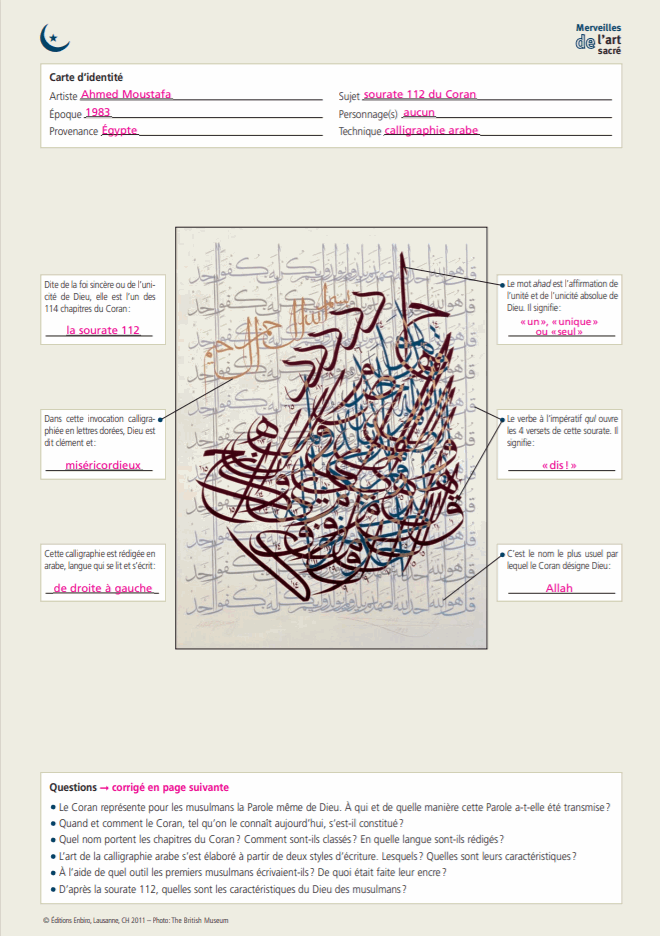
In Switzerland, this material was published by Enbiro. It is peppered with religious vocabulary, yet « sounds the death knell » for faith, as follows:
When we talk about religions, we usually think of sacred texts, of doctrines developed over the ages, of moral precepts sometimes at odds with social reality, or even of rites marking the personal or community life. But we must not forget the essential role played by religions in the history of the arts, which form an important part of humanity’s heritage.30
According to the laïc model, no religion31 is recognised; they are all myths to be lumped together.
We shall address only a few points from this teaching material, at least to check whether the religious » fact » is taught in a factual and historical manner.
The leaflet on Islam in the » Wonders of Sacred Art » series caught our attention as it is the most controversial religion:
It includes exercises to complete: 32
1) A declaration of sincere faith or of the oneness of God, it is one of the 114 chapters of the Qur »an:
Surah 11233
This is false or misleading!
a) Each of the four ayat (verses) in this surah is contradicted by other ayat in the Qur »an or by the hadiths. We shall not elaborate on these points due to lack of space.
b) The Islamic faith does not encourage sincerity34 Generally speaking, Muslim scholars teach that Muslims should generally tell the truth to one another, unless the lie is intended to « smooth over differences » or « gain the upper hand over an enemy ». Allah is not sincere; He repeatedly presents Himself as » the best of deceivers35«
There are several forms of lying permitted for Muslims in certain circumstances, the best known being taqiyya (a Shia term). These circumstances are generally those which further the cause of Islam – in some cases, by gaining the trust of non-believers in order to expose their vulnerability and defeat them, or by concealing one’s faith when it is expedient .
c) Are we talking about Allah or God ?36
The Qur »an never tires of repeating the formula expressing the oneness of Allah, and the 112th Surah, devoted specifically to this subject, is said, according to Muslims, to account for a third of the entire book.
In his commentary, Zamakhshari recounted that Muhammad had declared: « The seven heavens and the seven earths are built upon this surah, and whoever recites it will enter Paradise. » Yet, despite this emphasis placed by Muslims on the doctrine of the Oneness of God, and despite the fact that it is this aspect of their creed which is their pride and glory, most writings describing the religion of Muhammad in order to examine his conception of Allah have been neglected. It is all too easy to be misled by a name or by etymologies. Almost all writers take it for granted that the Allah of the Qur »an is the same being and possesses the same attributes as the God of Judeo-Christianity. This view is incorrect, and results in a distorted philosophical attitude towards this religion.
d) Muhammad, whilst not being called a god in the Qur »an and the hadith, possesses the attributes of a god alongside Allah. Allah must submit to his will and must pray to him.37
2) The word ahad is an affirmation of the unity and absolute oneness of God. It means: « one », « unique » or « alone »
Wrong!
ahad appears 23 times in the Qur »an, in 23 ayats (verses), and always means « one among others », with the exception of Sura 2:102, where ahad, in a negative form, means « none or nobody ».
Surah 21:17 states :
If We had wished to take a diversion, We would have taken it from Ourselves, had We truly wished to do so. (French translation by Hamidullah, capitalisation as in the original)
But the Arabic text, or the best German or English translations of the Qur »an, read » « from amongst us « ». As if Allah were not unique by nature. Basically, this ayah is rather odd – would Allah need to amuse Himself with women(?). This is a denial of Allah’s oneness, suggesting that if He had wanted to have » a good time » with a sexual partner, He would have taken her from among them.
It is the term Wahid which means: unique, the one and only38. A similarity can be found in the Hebrew Holy Scriptures with e. Ehad, which is used for our triune God, always indicates a composite unity (Gen 2:24) and also wahid—unity such as that of the only Son (never used to refer to God).
The well-known expression, allah hu akbar, means « Allah is the greatest (or the broadest) ». Greater than whom? Comparing this god to others shows that he is not unique by nature. This expression dates back to the time when Mecca was a sanctuary of idols; there were three great gods: Lah and Baal (gods of the moon) and Uzat, their daughter. Lah was the greatest.
3) In this invocation, written in calligraphy in gold letters,
God is described as merciful and compassionate
False or misleading! Once again, it is not God (pure and simple) that the Qur »an speaks of, but Allah. laïcity, known as « incompetent » in matters of religion, has also lacked « intelligence ».
Furthermore, Allah is anything but merciful according to Islam’s primary sources: the Hadith and the Qur »an. Allah’s mercy is sectarian and sexist, showing no mercy towards women and slaves; see our previous issue. The influence of laïc education discredits the Judeo-Christian virtues and terms, which have defined our vocabulary for centuries.
The laïc gospel spreading across the world seeks to encourage mercy social across all religions. A series of English-language videos entitled « The Secret Life of Muslims », made by a Jewish filmmaker in search for hope and compassion in a world without hatred, shows how we are all brothers and sisters in our shared humanity. Some of these clips rightly highlight the absurdity of the West’s hatred towards Muslims, and recall the example of Mohammad Bezek39, who cares for terminally ill children with disabilities, abandoned at birth in the USA . This work will remind atheists and the « Christians » on the « broad path »—who are asleep—of the meaning of a religion that is not in vain. (See James 1:26–27).
We are all descendants of Adam and Eve and of Noah, and are subject to the same laws. See Gen 3:9–19, Gen 8:21–9:17. It is a noble aspiration within the humanism of this century to seek to put an end to all hatred amongst men.
Bernard Prunneau, in his article « Lest the cross of Christ be made of no effect », provides a definition of a « social gospel » that is very much present in Roman Catholicism.
« The social gospel speaks of the defence of human dignity and freedom. The Good News of God’s grace reminds us that the guilt and corruption of humanity made Jesus » sacrifice necessary, to strip him of his old nature and make him a new creation. Religions have no part in this truth and, not only can they not be other, « less direct » paths to God, but they are genuine dead ends and lead us away from our Creator. The Bible, the Word of God, proclaims this from Genesis to Revelation. The world’s religions, even with all their outward displays of piety, humility, wisdom and good works, will remain, until the day of Jesus Christ’s glorious return to earth, nothing but paths of darkness and places of captivity. Our Lord Jesus, however, is for ever « the true light which, coming into the world, enlightens every man » (John 1:9). Jesus is indeed the only Shepherd of the flock, the only Master of the , the only Vine of the branches, the only name given to mankind by which they may be saved (Acts 4:12). «
4) This calligraphy is written in Arabic, a language that is read and written: from right to left.
Correct : Finally, a factually correct piece of information; it will be the only one on this entire page about Islam.
5) C is the most common name by which the Qur »an refers to God :
Allah
False or biased !
This is what is taught to the unsuspecting in order to convert them to Islam. But Muslims themselves reject this claim. The Malaysian government40 prohibits Christians from » use of the term « Allah » in their Bibles, even though this has been the practice in countries where Islam has been the majority religion for centuries, such as Malaysia and Indonesia.
« Allah » is a compound of a preposition and the name of one of the gods of the Kaaba, whereas the term « God » is not a proper name and refers to a being who is distinct in nature, deeds and holiness. We shall let Christian Prince, a native Arabic speaker and graduate in Islamic civil and canon law (the famous Sharia), explain the term « Allah » to us41 :
This is why the moon features on many flags of predominantly Muslim countries. The name commonly used for the Judeo-Christian God is Yahweh, and even this term is an attribute rather than a name (which would be meaningless if it stood for nothing): it means « I am »; his existence and eternity depend on nothing and no one other than Himself.
Before we can understand the person of Allah, we must first understand his name. Muslims try to make us believe that Allah is identical to the God of Christianity and of Moses. They even try to convince us that Allah42 is an Aramaic word word used by Jesus. How true are these claims?
When the film « The Passion of the Christ » was released a few years ago, Muslims took extracts from the film in which Jesus spoke Aramaic whilst uttering the name of God. They then used these clips to prove their claim that the name « Allah » is indeed Aramaic. The Aramaic word they were trying to adopt was « Elah »; this « El » is not the « Al » in « Allah ». In Surah 4:125 of the Qur »an, there are two terms for Allah, but they do not mean the same thing. You will not notice any difference apart from a single letter, but in reality, the difference between them is significant.
The first is للّ (lillah) and the second is ُهَللّٱ (Allah). In Arabic, al means « the »; if we remove the Al from Allah and the lil from lillah, we are left with lah (god). In fact, lah was the name of the moon god, an Egyptian deity worshipped by the Arabs. In French, lillah translates as » to God (or to the moon god) » and Allah as » the God (the moon god) « .
In Arabic, al always means « the » and is attached only to names attributed to God. This is why the 99 names of Allah begin with Al. Note, however, that « the » » is not part of the name. It is simply a device used to indicate that the name is unique to God – only God can receive this distinction. For example, we cannot say « The Muhammad », as Muhammad is merely a name for a person.
It is interesting to note that the Messiah is called Al-Maseeh in the Qur »an. This means that he is the only Messiah in the whole world. He is the only person in the Qur »an to have Al or « The » attached to his name.
Who is this Lah? He is the god of the moon, but how Lah can he be the god of the moon if the Qur »an forbids the worship of the moon and the sun?
6) All over the world, the faithful [Muslims]43 turn towards this square structure to praise God [Allah]:
the Kaaba
False and misleading :
This information is false in the days of the first mosques. The direction of prayer (the qibla) has already changed four times. See our previous article.44 We shall use this lesson to show how science and history help us to assess this » religious fact « .
Truth of laïc courses on the religious phenomenon
These laïc lessons on the « religious phenomenon » admit that they do not claim to provide historical teaching or even to address the question of truth. We certainly agree! But they actually stand in opposition to history, truth and science !
Almost all the points covered bythis teaching material reveal shortcomingsunworthy of a scientificjournal. The expected expected objectivity should have led to greater « expertise » in the preparation of the teaching materials.
The majority of sects do not attempt to understand their own history objectively. This culture does not allow for criticism, nor even for neutral reporting of the facts. People with Arabic names were involved in drafting this teaching material. It is suspected that a bias towards their religion, which is neither scientific nor historical, has been introduced. Islam, as presented in this course, is portrayed as harmless. All these courses serve as a basis for « well-meaning » advocates of laïcity to build a superficial peace between religious communities, built on sand (Matt 7:26).
The Importance of History in Politics
It highlights the vanity and absurdity of false gods and false prophets (Deuteronomy 18:22). The Word of God exhorts us not to forget the past, through calls to « Remember » (Revelation 3:3; Micah 6:5 😉 or « Remember » (Deuteronomy 4:10; 8:2; 24:9; 25:17). This past is a collection of living stories and our relationship with God. This past shows that God « t a God of » religions, myths, traditions » (the product of our imagination), but a living God who interacts with his people.
The network for educational creation and support, canope.fr45 presents the laïc teaching of religious facts as follows, in accordance with the values of the Republic :
In his speech on 21 January 2015, the President of the Republic stated:
« Religions have no place in schools. This does not, however, preclude the provision of laïc education on religions. »
In the school context, the phrase « teaching is laïc » is almost redundant, as the Charter of laïcity (Article 12) reminds us; yet laïcity in no way prohibits discussing religions at school, but rather leads to approaching them from an academic perspective, placing them within the realm of knowledge rather than that of the transmission of faith or the sharing of experiences.
Following debates in the 1980s, spearheaded in particular by the Ligue de l »enseignement, and several reports, including that by the historian Philippe Joutard in 1989, the first implementations appeared in the history and literature syllabuses in 1996. The French approach, confirmed by the report by the philosopher Régis Debray in 2002, is indeed to teach religious facts through the school curriculum. The Debray report emphasised the need to take these into account in language lessons, social sciences, philosophy (the concept of religion) and scientific subjects, by linking them to the history of science, and now to the history of the arts, and in certain respects through moral and civic education [2].
The laïc position is not neutral and never has been:
The laws of the Republic were forged in the workshops of Masonic lodges. Freemasons believe they were enlightened during their initiation. But what light are we talking about, if we reject the light that comes from above ?
laïcity born of incompetence
The Republic does not (re)cognising any god46, it acknowledges that it lacks the tools to judge religions or sects. The proponents of laïcity openly admit this.
The aim, then, is to move from a « laïcity of incompetence »47 (in the legal sense, religious matters are none of our concern) to a « laïcity of intelligence » (it is our duty to understand it) by drawing a clear distinction between the religious as an object of worship and the religious as an object of culture. Religious phenomena are thus contextualised and put into perspective as objects of knowledge.
This « laïcity of intelligence » will not enable us to identify a pernicious cult before it has caused harm. And even if it is too late, its actions remain ineffective.
laïcity has manifested itself in its dogma of anti-discrimination legislation regarding religions, which has been taught to us since 2009. It is worth noting that the security of the Republic and of airports was not jeopardised when Parisian airports dismissed around twenty employees simply because they were Muslim, following the Charlie Hebdo attacks. At various airports across Europe, these dismissals have since been called into question.
What a contrast to Judeo-Christian wisdom. This calls for reverence for and obedience to the Lord : See Deuteronomy 4:6–8 ; 32:28 ; 1 Kings 3:9–13 ; Job 38:2–4, 36 ; Proverbs 1:1–2, 7 ; 2:2–6 ; 3:13–19 ; 4:5–7 ; and finally Proverbs 9:10 : 30:5–6 ; Psalms 111:10
The spiritual person, on the other hand, judges everything, and is not judged by anyone. 1 Cor 2:15
In November 2015, following the Charlie Hebdo attacks, it was clear to all the security services that reconciling respect for religions with national security was a difficult task. The press at the time spoke of a » radical interpretation of the Qur »an « 48. This view is inaccurate and remains » lacking in insight » when it comes to reaching the hearts of a sect’s followers. By distancing itself from its Christian roots, laïc Europe refuses to address the truth of the Holy Scriptures.
As the geopolitical analyst Alexandre del Valle points out49, various Islamist factions, such as the Muslim Brotherhood in France50 know how to exploit the Achilles » heel of the Republic: human rights, laïcity and anti-discrimination legislation.
It is important to recall the fundamental aspects of the 1905 Act: it ensures freedom of conscience51 and guarantees freedom of worship52. A clear understanding of what freedom to believe or not to believe entails – which goes beyond and encompasses religious freedom – helps to avoid a common confusion between laïcity and atheism. (Canope.fr )
laïcity is a proselytising form of atheism, but one that conceals itself and does not admit to it.
What is meant by « freedom of conscience »? Can everyone believe whatever they want? That means nothing when everyone already believes what they want. Freedom of belief within Christianity, on the other hand, permits neither credulity nor folly.
Reject profane tales and nonsense. 1 Tim 4:7
Nor does this « freedom of conscience » permit vain and profane forms of worship. See Acts 7:42; Col. 2:18.
… let us show our gratitude by offering God worship that is pleasing to him (Heb 12:28)
laïc institutions allow everyone to believe in anything and everything, but prohibit any form of public religious teaching other than that of laïcity. They then oppose Judeo-Christian values and condemn them.
The language of laïcity in France
The serpent was the most cunning of all the animals of the field that the Lord God had made. It said to the woman: Has God really said: Genesis 3:1
laïcity first sows doubt, but it does not stop there.
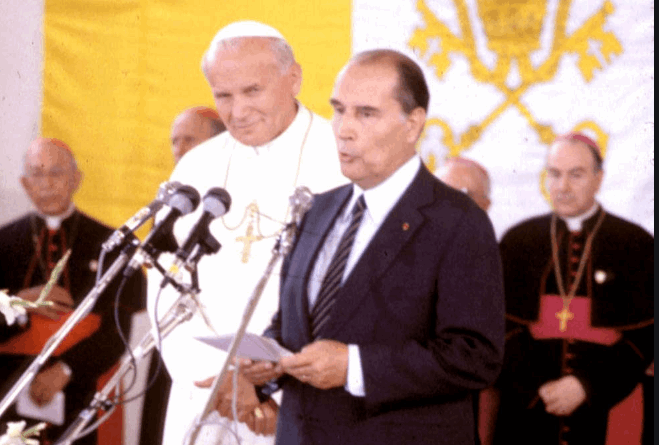
François Mitterrand asked himself some questions :
« I don »t know whether I believe or whether I don »t believe… I ask myself this question; I have no answer, but it is the sort of issue that concerns me. »
he said in 1976, as he approached his 60th birthday. This laïc religion, which seeks to exclude God from schools, leaves its flock in a state of uncertainty. And the multitude of religions shows that God remains the missing piece in the heart of mankind.
I have seen the work with which God has occupied the sons of man. He makes everything good in its time; he has even placed the thought of eternity in their hearts, though man cannot fathom the work that God does, from beginning to end. Eccl 3:10–11
Presidents Jacques Chirac53 and Emmanuel Macron54 distanced themselves from the Christian roots of Europe, but insisted on entering St Anne’s Church in Jerusalem without Israeli security.
The Head of State did not wish to enter Notre- during the funeral of Johnny Halliday, but immediately paid his respects55 to it following the fire in 2019.
Vincent Peillon56, born in 1960, is a French politician and professor of philosophy.
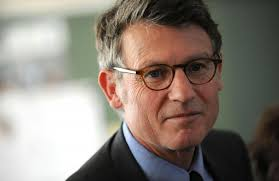
He wants to give pupils a choice :
» the aim of laïc ethics is to enable every pupil to become self-reliant, because the starting point of laïcity is absolute respect for freedom of conscience. To grant freedom of choice, one must be able to free the pupil from all forms of determinism – familial, ethnic, social and intellectual – so that they may then make a choice « 57
But what kind of liberation does a choice bring? Interviewed in 2012 on the subject of laïcity, he clearly stated that laïcity is an invented religion :
We will never be able to build a country of freedom with the Catholic religion, but since we cannot acclimatise Protestantism in France either … we must invent a republican religion. This republican religion, which must accompany the material revolution but which is a spiritual revolution, is laïcity. And it is why, moreover, at the beginning of the 20th century, people spoke of laïc faith and laïc religion, and why laïcity was intended to be the creation of a public spirit, a laïc morality and thus adherence to certain values… laïcity would be stronger today if it were conceived… as a genuine commitment to and a genuine spirituality in its own right, which was the view of Jaurès and Buisson … 58
We should also note the bellicose language used
» There is an ideological battle to be fought « ,
and by proposing laïcity as the guide (führer) for a new path which will eventually replace the one identified as « The Way » (cf. John 14:6)
« This intellectual work must be the beginning of a path »
In one of his books59, he explains how to strip away Judeo-Christianity by erasing its history.
« The French Revolution is the irruption into time of something that does not belong to time; it is an absolute beginning; it is the presence and the embodiment of a meaning, of a regeneration and « an expiation of the French people. 1789, that peerless year, is the year of the birth —through a sudden leap in history—of a new man. The Revolution is a meta-historical event; that is to say, a religious event.
The revolution entails the total forgetting of what preceded it. And so the school has a fundamental role, since the school must strip the child of all their pre-republican attachments in order to raise them to become citizens. And it is indeed a new birth, a transubstantiation that takes place in the school and through the school—this new church with its new clergy, its new liturgy, its new tablets of the law. «
… Then the serpent said to the woman: You will not surely die; Genesis 3:4
Having sown doubt, he then denies the Bible:
- Creation
- The Chosen People
- T « work of Christ on the cross
replacing it with New Age esotericism :
It is a religion of freedom, a religion of human rights, a religion of shared humanity, a religion of education and free inquiry; it is a somewhat heterodox religion in the sense thatit draws draws on a whole tradition found both in Kabbalah and in the Enlightenment, with the idea that, fundamentally, it is up to humankind to continue divine creation, so we also have a historical responsibility – what is known as the theology of freedom – meaning that the work is not yet complete, we must carry it forward; we have this mission and, as I say, a democratic religion in the sense that, just as the incarnation through Jesus, a single man … their idea is that the divine must be embodied in all people, on an equal footing ; no clergy, no intercessor between God and conscience, no chosen people either … nor any theory of grace or election, and a rejection of original sin as well … this does, after all, encompass many of the world’s religions which have developed … within republican and socialist circles.60
Mr Peillon is indeed inspired by Ferdinand Buisson, one of the founding fathers of French laïcity and the theorist behind the « laïc faith ». In the conclusion to his book dedicated to this great figure—winner of the Nobel Peace Prize in 1927—the minister summarises his doctrine in a few striking phrases:
» The republican man is a religious being. Opposed to the idea of a sinful nature and a predetermined history, the whole movement of thought consists in seeking to realise, through a progressive, gradual and embodied process, the personality of Jesus (…) The perfectibility of our nature leads us to wish to be republican Christs « .
« Republican religiosity—moral and political—rests on an anthropology (…) capable of producing « a new humanity » [Edgar Quinet]. .. Republican religiosity—without dogma, without ritual, without priests, a laïc religion uniting all denominations—is the affirmation of an ideal through which we transcend ourselves, both individually and collectively… What is at work in history is the free and mystical spirit (…). This republican religion is a heresy (…) for the whole process, through laïc faith, consists precisely in changing the very nature of religion, of God, of Christ, and in definitively defeating the Church. Not only the Catholic Church, but every Church and every form of orthodoxy. Human deism, the humanisation of Jesus, religion without dogma, authority or Church—the whole enterprise of laïcity consists not in abandoning the ideal, the infinite, justice and love, the divine, but in bringing them back into the finite in the form of a demand and a task that are at once intellectual, moral and political. … « 61
___
» We must shape people who uphold a certain set of values «
It is, at heart, a religion that will oppose all orthodoxies, all dogmas … Any man can become a republican Christ … The Gospel message, the message of Jesus, is fulfilled far more fully by the socialist revolution itself, radical socialist, republican revolution than by any other means. To establish the republic, we must invent a spirituality, or even a specific religion … For the republic to take root, it needs to forge its own religion … known as laïcity.62
True to the values of Freemasonry
Peillon was a guest of the Grand Orient on 16 November 2012 :
Although not a Freemason, Vincent Peillon has written extensively on the thinking of Ferdinand Buisson, the right-hand man of Brother Jules Ferry, the father of public education in France, and on Pierre Leroux, a Freemason who championed a fraternal and spiritualist form of socialism in the years 1848–1870.
One of the guests at the event remarked :
« Peillon shares our values; he is a Freemason without an apron »63
It is true that laïcity does not present itself as a virulent form of neo-atheism, but it is nonetheless a form of atheism – a cunning one, as it conceals itself. Atheism is by its very nature contradictory: it denies the existence of The Truth, yet, being an absolutist doctrine, it creates a new truth. laïcity tolerates religions provided they are regarded as subjective experiences, based solely on mythical belief. It prohibits any public teaching that would dare to contradict its worldview, under the guise of neutrality.
The Bible’s response: Fool!
The Word of God describes as a fool foolish anyone who does not believe in God (Hebrew: nâbâl: the term also means stupid, wicked, vile, ungodly)
To the chief musician. A psalm of David. The fool says in his heart, « There is no God. » They have become corrupt; they have committed abominable deeds; there is none who does good. Psalms 14:1
The term nâbâl appears for the first time in:
Will you blame the Lord for this, you foolish (nâbâl) and unwise people? Is He not your Father, your Creator? Is it not He who formed you and established you? Deuteronomy 32:6
This verse confronts the Jewish people with the truth of God’s existence, in that:
- God’s name is mentioned: Yahweh = I Am
- this people has a beginning and therefore a Father who created them,
- a creature implies a creator
- God formed, accompanied and strengthened his people:
The factual and miraculous history of the Jewish people testifies against them and against us. The deliverance from Egypt was promised to Abraham after 400 years of slavery; this deliverance is known throughout the world as a miraculous event. Even today, attempts are still being made to explain the ten plagues of Egypt with « natural » explanations.
The Septuagint (the Greek translation of the Old Testament completed in the 2nd century BC) uses here the Greek term (mōros: foolish, mad), which is found in the Gospels in Matthew 7:26
And whoever hears these words of mine and does not put them into practice will be like a foolish man (mōros) who built his house on sand;
The house of laïcity is a shaky house built on sand. At the height of their conviction, certain Freemason leaders in the « anti-cult » struggle took a dim view of the term cult, following the attacks in Nice and at *Charlie Hebdo*; they boldly asserted that one must not confuse a sect with a religion. What confusion and contradictions there are when one refuses to judge religious matters despite their consequences.
Richard Wurmbrand in prison Freedom of education in Europe
In 1848, during a congress of the Romanian Communist Party broadcast live on the radio, state-backed pastors affirmed the country’s religious freedom.
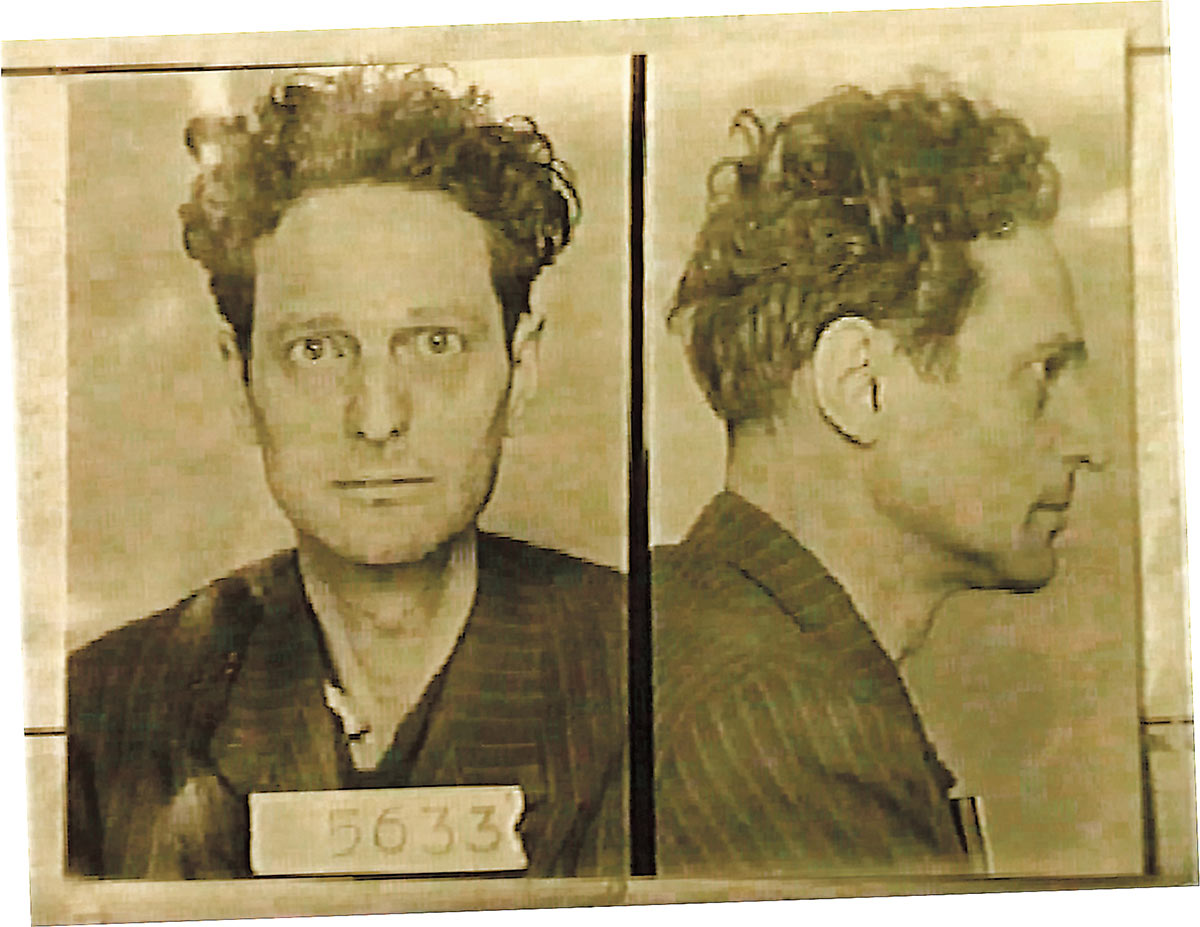
The Protestant pastor and Messianic Jew, Richard Wurmbrand, was present with his wife, Sabrina. Sabrina told me:
» Richard, stand up and wash this shame from the face of Christ! They »re spitting in his face. » I said to her: « If I do that, you »ll lose your husband. » She replied: » I don »t want a coward as a husband. « 64
You will know the truth, and the truth will set you free. (John 8:32)
He stood up, and it was precisely by publicly denouncing the ban on Christian education for children that he began 14 years of torture in Romanian prisons.
He has written more than 18 books, the best known of which is : Tortured for Christ. Versions of his works have been translated into more than 65 languages. He founded an international organisation that helps Christians around the world who are persecuted for their faith.
In France, the a primary school teacher from a small village (Margencel -74) was deported to Dachau for refusing to make his pupils sing the unofficial anthem of the Vichy government:
» Marshal, here we are…
Before you, the saviour of France
We swear, we, your lads
To serve and follow in your footsteps
You have fought tirelessly
For the common good …
You have restored hope to us …
Your genius and your faith …
The fatherland shall be reborn « 65
He never returned.
Although freedom of » worship and conscience » is guaranteed in Europe today, a historian wishing to give truth its due weight will not be able to teach about religions objectively. Will they have to stoop to concealing the truth about various religions, including that of laïcity?
What, then, of the Christian who judges a teaching to be false and anti-Christian?
The spiritual person, on the other hand, judges everything, and is himself judged by no one. (1 Cor 2:15 )
The « Expo-Dieu(x) » catalogue:
Sexuality, from a laïc perspective
The catalogue « God(s): A User’s Guide » introduces the subject as follows:
— Why are religions wary of sexuality? Let us first note that not all religions are necessarily wary of sexuality; Tantric Hinduism even goes so far as to integrate it into the spiritual experience. This wariness is primarily characteristic of monotheistic religions, chiefly Christianity, which regards sexuality as a savage and e egoistic, which must be restrained and channelled.
Unsubstantiated claim : No text is cited to support this statement! The Scriptures do not treat the beauty of love in all its dimensions as taboo, and present it not as an impulse but as a thoughtful and shared act. (Song of Songs, by Solomon 7:3–10; 8:10)
This is why those closest to God (priests, monks) take a vow of sexual abstinence. For ordinary people, control over sexuality is exercised both through the outright prohibition of sexual practices deemed reprehensible (adultery, homosexuality, masturbation, incest), as through the establishment of strict rules governing sexual activity (permissible positions, rules of purity regarding sexual contact), which is permitted only within marriage.
Let us recall the facts: Priests and pastors were married in the Bible; Christianity condemns sects and …
« false teachers… who forbid people to marry« . (1 Tim 4:1–2).
Nowhere do the Scriptures discuss the « lawful or unlawful status » of a married couple. It is solely the preserve of sects66 to meddle in what goes on in the marital bed. This laïc view gratuitously distorts Judeo-Christian tradition, equating it with the heresies it denounces.
Claiming to be wise, they became fools; (Rom 1:22)
Finally, would pederasty and incest67 have they already become « natural » according to this laïc religion which has no prohibitions? In this respect, it would align itself with Islam to conclude:
… The extreme case of female genital mutilation clearly illustrates the desire to sever, once and for all, the link between the two functions of sexuality: pleasure and procreation. (page 217)
The laïc conflation seeks to portray God as a killjoy. Safeguards regarding sexuality exist for the sake of children and the couple. They are endorsed by doctors, social services and humanitarian organisations when sexuality becomes a source of impurity or enslavement.
God created man in his own image; in the image of God he created him; male and female he created them. (Genesis 1:27 )
The Greek word (porneia) for fornication covers a range of sins that directly violate the ethical68 sexual standard and God’s design for marital union. Associating sexuality solely with « free » hedonistic pleasure comes at a family and social cost: AIDS, another scourge, claims more than 100,00069 lives every month.
Einstein and the atheists
« God does not play dice »
This famous quote by Albert Einstein was delivered at the Solvay scientific conference70 in 1927. He condemned atheism amongst scientists.
« Fanatical atheistsare like slaves who still feel the weight of their chains, which they have cast off after a hard struggle. They are creatures who – in their resentment against traditional religion as « the opium of the masses » – cannot hear the music of the spheres « 71
Einstein may not have sought or found the one God and Creator in the history of his people (he was Jewish), but he at least acknowledged his existence.
… what can be known about God is plain… (Rom 1:19)
His scientific motivation was also as follows :
« I want to know how God created this world. I am not interested in this or that phenomenon. I want to know His thoughts; the rest are mere details. »72
When asked by a writer73 about his view of pantheism, he replied :
I am not an atheist. I do not know if I can describe myself as a pantheist. The issue at hand is too vast for our limited minds. May I answer with a parable? The human mind, however well-educated, cannot comprehend the universe. We are in the position of a small child, entering a vast library74 whose walls are lined from floor to ceiling with books in many languages. The child knows that someone must have written these books. It does not know who or how. It does not understand the languages in which they are written.
Yes, God has enabled man to recognise God’s existence by observing creation.
He has made everything beautiful in its time; and He has set the world in their hearts, so that man cannot fathom, from beginning to end, the work that God has done. Eccl 3:11
How unfathomable are your thoughts to me, O God! How vast is their number! (Psalm 139:17 )
It is indeed impossible to know God without his Word. Cf. Proverbs 30:5–6. But those who are willing to listen will realise that God has spoken to us on many occasions—through his creation, through the prophets, through his mighty hand which has guided and delivered his chosen people right up to the present day, and through His Son.
Having at various times and in various ways spoken to our forefathers through the prophets, God, in these last days, has spoken to us through the Son, whom He has appointed heir of all things, through whom He also created the world, Heb 1:1-2
Einstein did not play the dice, but this exhibition is inspired by atheists who play at being gods, or with the gods.
Conclusion: The religious experience today.
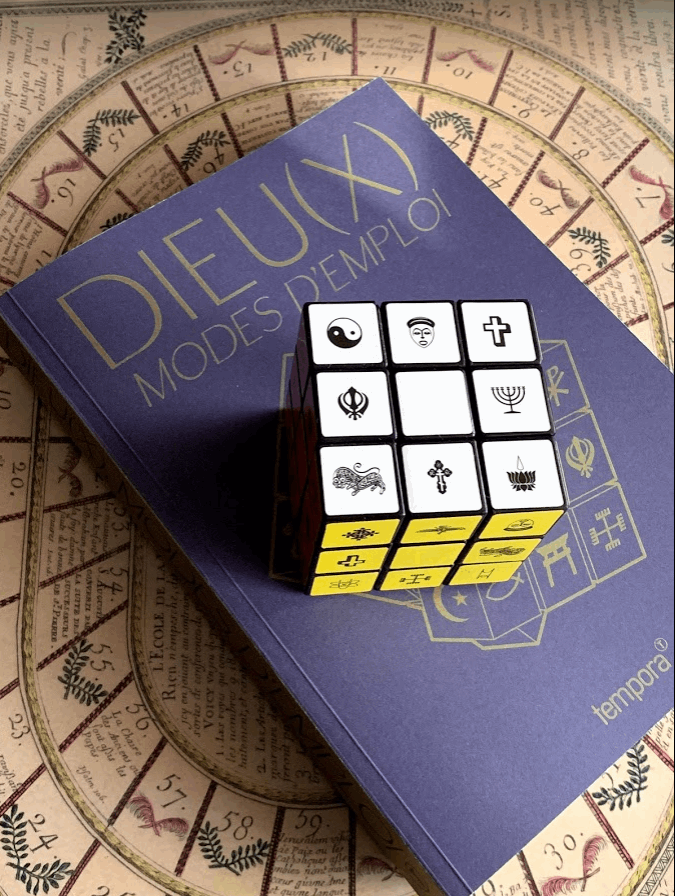
The Rubik’s Cube of all religions aptly expresses this world view&n bsp;: Harmonising the religions of different peoples is a game, but it is also a puzzle for humankind.
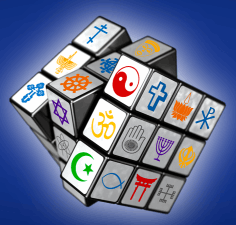
This international exhibition presents and explains an attempt at a » solution for today » : laïcity75. Gods are like playing cards that can be turned over and manipulated. We must unite, » join forces » against any » Truth » that » chains us down « .
We therefore inevitably need « instructions » from the creator (Man) so that peoples may distance themselves from their gods, which we understand to be fabricated. We must learn to « use » them harmoniously in their hands.
The psalmist responds perfectly and in every respect to this futile attempt to » break the bonds » that the nations have with the One who does not dwell in » temples made by human hands « . Only his Anointed One can bring peace to the heart and to the nations. Let us « tremble », knowing that God will not be mocked with impunity, and let us receive His « instructions ». Blessed are our children who trust in Him.
The gods invite themselves to Geneva
It is indeed gods (Gen 3:5) who have invited themselves to Geneva and elsewhere—men who guide and judge, who take themselves for gods, who oppose history and truth, and who teach this to others.
I said: « You are gods; you are all sons of the Most High. » Yet you will die like men; you will fall like any prince. Arise, O God, and judge the earth! For all the nations belong to you . Psalms 82:6–8
… and where is God in all this?
The philosopher Régis Debray concludes this religious catalogue with a long text, of which we shall reproduce only an extract :
« And what of God in all this? » « Sire, I have no need of that hypothesis, » replied Laplace to Napoleon, who had asked where he placed the Eternal Father within his system. If one is willing to consider the breadth and depth of atheological religions—those without a single God, such as Hinduism, Buddhism and Conf , forms of wisdom that have gradually become religions — Laplace’s famous remark is in no way blasphemous. Let us not make monotheism an obsessive fixation, unless we are prepared to renounce even the slightest opening of the compass.
Could this be an oblique way of referring to Freemasonry, the great spiritual sister of laïcity, whose emblems are the set square and compass ?
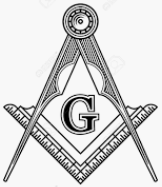
As for the God who created heaven and earth, of whom our Bible is, in a sense, the authorised two-volume biography (Old and New Testaments) …
This division into two » Testaments » (covenants) is not intrinsically Judeo-Christian; some believers remove the blank page between the OT and the NT from their Bibles. The Bible is a whole; the God of the NT is also the God of the OT.
it is not sacrilegious to outline its history and geography. He who, to the abstract oneness of Aton—properly hailed by Amenhotep IV in his hymn (« You are one and there is no other »)— adds the power to punish, to console and to fly into a rage. He, therefore, who is not content merely to exist but who thinks of us, and even of me personally, may rightly be called a Christian — it is fairly easy to piece together his background by examining the evolving and dated relationship between man and the Eternal One. His date of birth, though a matter of debate, is around — 600 BC, that of Deutero-Isaiah … (page 309)
We shall leave it at that; whilst these remarks may not be clear to everyone, the fact remains that science and history are lacking, and this is the greatest criticism we shall level at this laïc exhibition, the aim of which is to teach inaccuracies.
What a disgrace: the « Expo-Gods » exhibition denies history
and archaeological discoveries
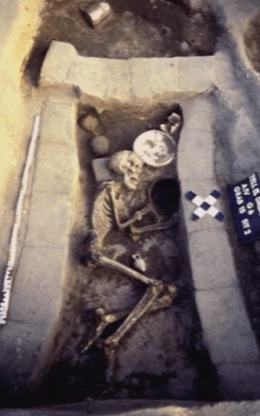
How could God, … or even Judeo-Christianity, possibly date back only to 600 BC ? When the first pages of the Bible were written around 1400 BC by Moses? The entire history of the Jewish people is being called into question. Yet the children of Israel left archaeological traces 76 in Egypt, at Goshen. There we find Israelite (Canaanite) tools, pottery and tombs.
The most significant reference to Israel outside the Bible is that on the Merneptah Stele (fig. below). Discovered in 1896 in Merneptah’s mortuary temple at Thebes by Flinders Petrie, the stele is a eulogy to Pharaoh Merneptah, who ruled Egypt after Ramses the Great, c. 1236–1223 BC.
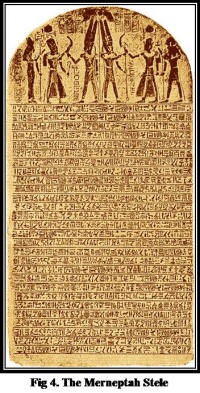
- A short section at the end of the poem describing a campaign to Canaan by Merneptah in the early years of his reign is significant for biblical studies. One line mentions Israel:
« Israel is devastated, but its seed is not. »
This is the first mention of Israel outside the Bible and the only mention of Israel in the Egyptian records. - This places Israel as a nation immediately after Joshua’s conquest of Canaan (1406 BC). (source)
He whose Name is I AM is eternal; He was not born with Moses, nor with Isaiah. His Word does not pass away like that of men who seek to cast Him out of heaven.
The oldest traces of civilisation bear witness to a precise knowledge of the main accounts of Genesis77, 2,500 to 3,000 years before Christ. The sages who created the Chinese pictograms refer to them. Neither Moses nor Isaiah invented anything.
God responds
He responds to our vain thoughts and to the arrogance of the wicked:
The wicked man says arrogantly: He does not punish! There is no God! -… He says in his heart: I do not falter; I am forever safe from misfortune! … Why does the wicked man despise God? Why does he say in his heart: You do not punish not? » Psalm 10:4–6, 13
and it is a blessing to be ready before the return of His Son.
Why this uproar amongst the nations, these vain thoughts amongst the peoples? Why do the kings of the earth rise up, and the princes join forces with them against the Lord and against his Anointed One? – Let us break their bonds, let us cast off from their chains! – He who sits in the heavens laughs; the Lord mocks them. Then he speaks to them in his anger, he terrifies them in his fury: It is I who have anointed my King on Zion, my holy mountain! I will proclaim the decree; the Lord has said to me : « You are my Son; today I have begotten you. Ask of me, and I will give you the nations as your inheritance, the ends of the earth as your possession; you shall break them with a rod of iron; you shall shatter them like a potter’s vessel. »
And now, O kings, act wisely! O judges of the earth, take heed! Serve the Lord with reverence, and rejoice with trembling.
Kiss the Son, lest He be angry, and you perish in your way, for His wrath is quickly kindled. Blessed are all who put their trust in him! (Psalm 2)
The final word of the « Expo-God(s) » exhibition: A hymn of praise to the one true God
The illustration on the last page of the catalogue shows a rosary with non-Latin script. It is likely that the publishers are unaware of its meaning; it is an Ethiopian rosary 78, of which here are a few lines :
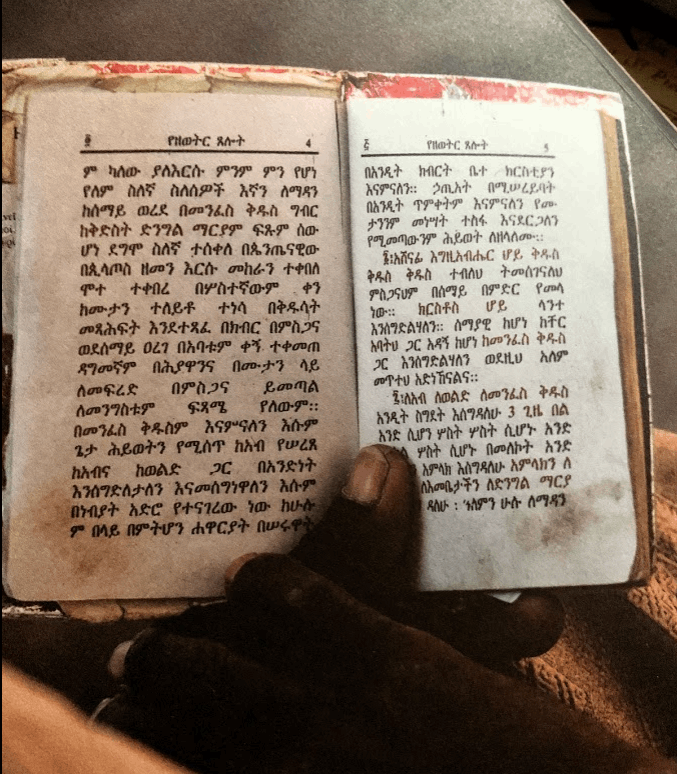
He came down from heaven to earth to save us. And we believe in the Holy Spirit and give thanks to the Father and the Son, who give life; We believe in the prophets through the prayers of the Most High; we believe in a glorious Church and believe in one baptism, the forgiveness of sins and the hope of eternal life to come.
This laïcity, which denigrates our God and assails us, leads us to place even greater trust in Him, to call upon Him in times of persecution, and to glorify Him.
Because you have kept my word of perseverance, I will also keep you from the hour of trial that is going to come upon the whole world, to test the inhabitants of the earth. Revelation 3:10
- 12 70 million inhabitants, of whom 87.2% are Muslim and 9.9% are Christian. Indonesia does not recognise agnosticism or atheism, and blasphemy is illegal.
- 2We use the term » « radical Islamist » for convenience’s sake, as Islam is, according to its sources, already radical.
- 3 Interview with the Indonesian Minister of Security: CNN Indonesia 26 November 2019 (YouTube D4T7uNfr0Pw).
- 4 Reforme.ch 2 March 2020: tinyurl.com/v5stv2x
- 5 In Israel, civil marriage is prohibited. A non-religious Jewish couple can only marry abroad.
- 6 China will rewrite the Bible and the Quran to « reflect socialist values » amidst the crackdown on the Uyghur Muslim minority – dailymail.co.uk/ 24 Dec. 2019. The crosses were to be removed from the country. The current plague (cf. Luke 21:11) seems to have delayed this project.
- 7 The Mila case: A second investigation has been opened into « incitement to racial hatred », in order, according to the public prosecutor’s office, to « ascertain whether the remarks made in the video posted [by the young girl: « Islam is a shite religion »] are of a nature that could constitute a criminal offence or whether they fall within the scope of freedom of expression, which is recognised for everyone and constitutes a constitutional principle ». See the article ;: marianne.net By Louis Nadau Published on 29/01/2020 at 12:20. :
- 8 expo-dieux.ch/
- 9 tinyurl.com/syp7gub
- 10 By « multicultural societies », we mean « multi-religious » ones.
- 11 No one is without beliefs; these young people are called upon and taught to believe in a shared hope and purpose.
- 12 The term indoctrinated may be used, since laïcity has its own dogmas and defines itself as a religion in this exhibition.
- 13 Arabic-speaking Christians come to Europe from Lebanon or Egypt during the summer to evangelise Muslims from Saudi Arabia or the Emirates, because it is not possible to do so in their respective countries. Some Muslims ask themselves: « Why are there so many crosses in this city? Why the cross? », and they convert and find joy in their hearts when approached and the Gospel is explained to them. Unfortunately, few European Christians take part in this work, and we now see that nominal European Christians prefer to let » live in peace » this religious microcosm.
- 14 In France, the term « cités » has, in fact, carried a negative connotation for several decades. What has seen a dramatic increase is, above all, a predominantly Muslim population. The quality of social life and the safety of people and property in the surrounding towns and villages have been adversely affected. One of my German colleagues, of Palestinian origin, tells me that the same phenomenon is taking place on a larger scale in Germany, following the mass influx of Syrian migrants. We state this fact not to stir up hatred towards Muslims—our duty being to love them—but to objectively describe what laïcity dishonestly refers to as religious » diversity « .
- 15 This museum is less well known as a treasure trove of works stolen after the revolution, and more as a glorification of humanity. Errata: We were convinced that it had 666 tiles, but this was a counting error. Three sides have 171 tiles each, whilst the fourth has 11 fewer tiles due to the door: 4 × 171 – 11 = 673.
- 16 Source: English Wikipedia
- 17 We were accompanied by a family with young children; one of the staff members insisted that the 4-year-old should not attend.
- 18 Catalogue of the exhibition » DIEUX MODE D « EMPLOI » p. 271
- 19 worldometers.info/abortions/10,553,000 abortions took place in these three months of 2020: January to the end of March. This is almost the rate of a heartbeat – 80 children aborted every minute worldwide.
- 20 That everything should be created out of nothing is absurd. Creation bears witness to this « inexcusable » error, according to Romans chapter 1: If, therefore, there is a Creator, He is not the myth created by a religion invented by man.
- 21 Les religions meurtrières (Champs actuel) (French Edition). Flammarion. Kindle Edition. ISBN Epub: 9782081389014: In 2015, as part of the « Champs » series, he notably published *Ten Theses on War and Israel: A Historical Portrait*.
- 22 Amazon describes the book as follows: » To mark the exhibition « Dieu(x), modes d »emploi », which opens to the public on 23 October 2012 at the Petit Palais in Paris, this eponymous volume offers a thematic overview of one of the few truly universal human phenomena: religion. « Divinities » , « Beyond », « Passages », « Cycles », « Cults », « Voices », « Places », « Bodies », « Intercessors », « Conflicts » – all these sections provide windows through which to grasp the full richness of contemporary religious and spiritual experiences. By the former Israeli ambassador to France. «
- 23 During the open evening of a freemasson lodge near Geneva, the « Grand Master » of the GODF explained that abortion had been introduced to prevent unsafe abortion practices that endangered the mother’s life. He referred to the « angel-makers » of the Middle Age, and the need to recall the context in which the laws were enacted, so that we do not forget the positive context in which they were developed. 80 children are aborted worldwide every minute.
- 24NSDAP = Nationalsozialistische Deutsche Arbeiterpartei, Hitler’s Nazi party.
- 25 Ideology of the Thule Society: (source: wikipédia.fr 2020)
- « The Order’s ideology was based on the belief in the existence of supermen and a superior human race: the Aryans, who were said to have originated in the hypothetical Hyperborea, the magical centre of the Germanic peoples. Most members are Ariosophists; some are initiated into Freemasonry, even though some of their ideas are radically at odds to that of « universal brotherhood »: the Aryan is said to belong to a human race of divine origin, whilst the Jew is considered to be a subhuman. «
- « Thule Society : (source: Wikipedia, English, 2020) : (German: Thule-Gesellschaft) was a group of occultists… founded in Munich shortly after the First World War, named after a mythical Nordic country in Greek legend. The society is chiefly known as the organisation that sponsored the Deutsche Arbeiterpartei (DAP; German Workers » Party), which was subsequently reorganised by Adolf Hitler into the National Socialist German Workers » Party (NSDAP or Nazi Party). According to Hitler biographer Ian Kershaw, the « list of the organisation’s members … reads like a « biographical dictionary » of the early Nazi sympathisers and leading figures in Munich », including Rudolf Hess, Alfred Rosenberg, Hans Frank, Julius Lehmann, Gottfried Feder, Dietrich Eckart, and Karl Harrer.
- 26Catalogue of the former exhibition at the Dachau Museum prior to 2002, ref. 17:
A branch of a Germanic order founded in northern Germany in 1912 was established in Munich in 1918. During the summer of 1918, the Munich branch set up its offices at the « Vier Jahreszeiten » hotel and operated under the guise of the « Thule Society ». The Germanic Order was a secret anti-Semitic lodge, organised along the lines of the Freemasons. Their principles were as follows: « Only third-generation pure-blooded Germans are eligible for membership; great importance must be attached to the dissemination of racial information; the principles of the « Alldeutsche » must be extended to the entire German race. – Everything that is non-German must be combated. » Julius Streicher, Rudolf Hess, Alfred Rosenberg, Gottfried Feder, Dietrich Eckhart and Hans Frank belonged to this circle of the « Thule Society ». One of the members, Karl Harrer, formed a workers » group within the organisation itself to look after the interests of nationalist workers. The German Workers » Party was founded on 5 January 1919, with Harrer contributing to the initial planning. On 12 September 1919, Captain Mayr, a member of the Reichswehr General Staff Gruppenkommando IV, sent a confidential agent to one of their meetings. His name was Adolf Hitler. « Origin and Nature of National Socialism » by Helga Grebing. « : Source: Catalogue of the former Dachau Museum exhibition prior to 2002, ref. 17 – kz -gedenkstaette-dachau.de )
- 27 Friedrich Engels Early Writings: Essays, Correspondence, Letters … p. 20 Springer Verlag, Berlin Heidelberg GmbH, 1920, … also in » Friedrich Engels, Briefe aus dem Wuppertal Geschrieben im März 1839. «
- 28 See Richard Wurmbrand’s very well-researched book: Karl Marx and Satan. We have reproduced it in seven articles on our website: vigi-sectes.org/karl-marx-et-satan-de-richard-wurmbrand-1- 7/
- 29 Several former Freemasons acknowledge that the light of Masonic initiation is a Luciferian light, but that only high-ranking Masons are aware of this. youtube.com/watch?v=VdY8LOjzMVM
- 30 agora-ressources.ch/merveilles/islam.html#
- 31The only religion that is not « vain » according to the Bible is not, strictly speaking, a religion that performs sacred rites, but is the manifestation of the works of the one who « has gazed intently into the perfect law, the law of liberty » (James 1 :26–27).
- 32agora-ressources.ch/merveilles/pdf/MERVEILLES_MUSULMANS_CORRIGE1.pdf
- 33Surah 112 in French: Say: « He is Allah, the One and Only. Allah, the One to whom we turn for all that we desire. He begot none, nor was He begotten. And there is none like Him. »
- 34See Qur »an 16:106; 3:28; 9:3; 66:2; 40:28; 2:225; 3:54 and authentic hadiths in Sahih al-Bukhari 52:269; 49:857; 84:64–65; 32:6303; 50:369, thereligionofpeace.com/pages/q uran/taqiyya.aspx
- 35 wikiislam.net/wiki/Allah_the_best_deceiver
- 36 answering-islam.org/Books/Zwemer/God/chap1.htm
- 37 See the Qur »an 33:56, as well as our previous articles in the RD
- 38 Most of the information we present in this chapter is drawn from our previous studies of the Qur »an or from an Arabist scholar, in this case Christian Prince, regarding the definition of terms: CP holds a degree in Islamic Civil and Canon Law (the famous Sharia); he possesses not only the skills required of a judge sitting in an Islamic court, but also the qualities of a historian, linguist and, finally, a debater. He analyses in depth the terms used in the Qur »an, the Hadiths and the Tafsir. He is the author of various books : *The Deception of Allah* and *The Qur »an and Science in Depth* in English, and *The Secrets of the Arab Prophet* in French.
- 39 This Muslim has cared for more than 80 terminally ill children in Los Angeles County. Mohamed Bzeek says that Islam « teaches me that if someone needs my help and I can help, then I must help them ». The Qur »an, however, a very different message regarding orphans, and Muhammad took the adopted son’s wife as his own.
- 40This is also what Muslims in Indonesia wish for, but no law has been enacted to this effect.
- 41Prince, Christian. The Deception of Allah Volume 1 (p. 4). Kindle Edition. Translated by vigi-sectes.
- 42 Editor’s note: Other terms also raise questions: Alhamdulillah (Qur »an 1:2) = »Praise be to Allah » « . How can Allah say « Praise be to Allah »? The one and only God is therefore speaking of himself in the third person.
- 43 We have added terms in square brackets to make the question clearer.
- 44We shall not discuss whether turning one’s backside towards the Temple in Jerusalem to worship a black stone shaped like a vagina constitutes a genuine » praise » to the God of Moses, Joseph, David and Solomon.
- History and science unsettle the sects. But Judeo-Christianity is based on a book of knowledge of the past and the future that history does not unsettle.
- 45 Only laïcity is permitted in schools. See reseau-canope.fr/les-valeurs-de-la-republique/enseignement-laique-des-faits-religieux.html
- 46 … but making a god out of the common ideal of humanity, united by initiation into a religion.
- 47 Régis Debray, The Teaching of Religion in laïc Schools. Odile Jacob, 2002, pp. 43–44
- 48 For their part, the French authorities, recognising the possible link between a radical interpretation of the Koran and armed jihadism, are adopting, under the state of emergency, measures which, whilst intended to combat the latter, immediately infringe upon religious freedom. https://www.cairn.info/revue-civitas-europa-2016-1-page-179.htm#no1
- 49 Watch the interview: The Muslim Brotherhood on the path to a global caliphate – Le Zoom – Alexandre Del Valle. youtu.be/BVSpgYUzpdE. Documents belonging to the Muslim Brotherhood were found after 11 September, describing plans to conquer Europe.
- 50… such as the Islamic apologist Zakir Naik, who claims to use European laws to defend Islam until Sharia comes into force. YouTube » Controversial Preacher Zakir Naik speaks to the Newsmakers « .
- 51 Freedom of conscience does not mean freedom of expression, nor freedom in state education.
- 52 In practice, however, freedom of worship is under threat in Europe. Certain Christian organisations are, to a greater or lesser extent, being prevented from carrying out their activities for questionable reasons (building regulations). In Italy, dozens of non-Catholic churches and mosques were ordered to close as early as 2017 (crossword.org letter from Milan, 6 Dec. 20 17) , before a complaint was lodged by Muslims at national level, leading to their reopening. In France, in Cergy St Christophe (95), during the 1990s, Evangelical Christians were refused permission to build a church on a plot of land they planned to purchase. This news was reported with satisfaction by the laïc authorities, who pointed out that Islam, on the other hand, integrated much better. A few years later, the local authorities authorised the construction of a huge mosque and the land was donated. Today, the suburb of Cergy St-Christophe has been transformed; it is no longer as safe as it once was to walk there at night.
- 53 1) It was, in fact, at President Chirac’s insistent request that the reference to Europe’s « Christian roots » was finally removed in 2004 from the draft preamble to the European Constitution. (la-croix.com 2019-09 -27-1201050439)
- 54 Macron, Emmanuel. Révolution (Hors collection) (French Edition). XO. Kindle Edition. : » This France of ours, republican by nature, has enemies. Republicans can never avoid naming them. These diverse enemies all have in common the fact that they are dreamers – though sometimes criminal dreamers – puritans, and utopians of the past. They believe they hold a truth about France. «
- 55 We will rebuild Notre-Dame, because that is what the French people expect. Because that is what our history deserves. It is our history, our literature, our imagination, the place where we have lived through all our great moments, our epidemics, our wars, our liberations; it is the epicentre of our lives, … It is so many books, so many paintings. It is a cathedral that belongs to all French women and men, even those who have never set foot there.
- 56 A leading member of the Socialist Party (PS), he served as Minister for National Education in the Ayrault I government from 2012 to 2014. He was a Member of the European Parliament from 200 4 to 2012, and again from 2014 onwards. He is the author of a book, « Let’s rebuild our schools ».
- 57 By AFP, Published on 2 September 2012, reported by lefigaro.fr
- 58 YouTube: « Vincent Peillon 3 – What is laïcity? » Source: Camille Tassel, Le Monde des Religions.
- 59 The French Revolution Is Not Over (Seuil, 2008): – see also christianophobie.fr/breves/vincent-peillon-delirant-antichretien-et-ministre#sthash.ZAmsFg3t.dpuf
- 60 Interview: youtu.be/3WNuugFF7Gg Vincent Peillon No. 2 – laïcity: a religion?
- 61 A Religion for the Republic: The laïc Faith of Ferdinand Buisson, Vincent Peillon, published by Seuil, 2011 (ISBN 2-02-098521-7), p. 277
- 62 YouTube: » Vincent Peillon 3 – What is laïcity? » http://www.laplumeagratter.fr/2012/09/05/la-morale-laique-de-vincent-peillon-ou-la-franc-maconnerie-imposee-a-nos-enfants/
- 63 Vincent Peillon lefigaro.fr le-nouveau-pouvoir-des-francs-macons.
The « Grand Orient » has a reputation for atheism.
- 64 Richard Wurmbrand, Tortured for Christ
- 65 A song from 1941 in honour of Marshal Pétain which schoolchildren in occupied France were required to sing. When the song was registered with the Society of Authors, Composers and Music Publishers (SACEM), the organisation detected an « obvious similarity » to a composition by Casimir Oberfeld, … a Jew, … who had been one of SACEM’s earliest rights holders on the eve of the German occupation; under the Vichy regime, he lost the right to register works with the society and the ability to receive royalties from . Deported to Auschwitz … he died during a « death march » in 1945. (source: Wikipedia)
- 66 In their reply to readers, Jehovah’s Witnesses explain what is permissible and what is not within a marriage: wol.jw.org/en/wol/d/r1/lp-e/1978130 .
- 67 The Muslim scholar Qurtubi mentions that incest is sometimes permitted if the girl is the product of adultery :answering-islam.org/Shamoun/incest.htm
- 68 The Bible provides clear details on sexual ethics and even describes God’s ideal for marriage, namely a man and a woman becoming one flesh (cf Matthew 19:1–9; 1 Corinthians 7:1–5).
- 69 worldometers.info/aids/: Over 440,000 AIDS deaths from 1 January to 5 April 2020 . Data from the WHO.
- 70 Einstein: « Gott würfelt nicht ». The International Institutes of Physics and Chemistry at Solvay in Brussels were founded by the Belgian industrialist Ernest Solvay in 1912. The institutes coordinate conferences, workshops, seminars and symposia devoted to open questions in physics and chemistry. (English Wikipedia).
- 71 goodreads.com/quotes/528444
- 72 goodreads.com/quotes/8409238
- 73 interview published in the book « Glimpses of the Great » by George Sylvester Viereck (1930). (en.wikipedia.org/wiki/Religious_and_philosophical_views_of_Albert_Einstein )
- 74 I remember a dream I had during an international Christian retreat, similar to Einstein’s « library of the world », but with a different outcome: It was a vast, concentric library whose tall, wide shelves all pointed towards a central space. People would appear in the central circle, one after the other, then ventured at random towards the shelves. Quickly captivated by the sciences they were studying (mathematics, physics, biology, etc.), they spent their lives there, confined between two rows of shelves. It was soon my turn to go to the centre and choose my path. I then said to myself: » I won »t be like the others who spend their lives in the same place; I »m going to explore the whole library first, before choosing a particular science. » I looked up and saw that the rows of books stretched on forever. Even a whole lifetime wouldn »t be enough to explore them all. I then thought to myself: « I »ll look after the people who read the books, and for that, I only need one book. » As a Christian and a scientist, I am convinced that it is the Bible that scientists need in their lives.
- 75 This religion places man at the centre; its « big sister » is Freemasonry. Jules Ferry, who was a Freemason, said: « I want a school without God »
- 76 https://patternsofevidence.com/The David Rohl Lectures – Part 2
- 77 We recommend the book in English which deals with the subject: *The Discovery of Genesis*, by Ch Kang and Ethel Nelson. We have verified the accuracy of the information provided with Chinese and Taiwanese speakers proficient in Classical Chinese.
- 78 We have produced a rough translation using Google Translate to identify the origin of this rosary: Orthodox in Amharic. It also contains a heretical invocation to the Virgin Mary. 43.5 per cent of the Ethiopian population are members of the Ethiopian Orthodox Church;