
But if some of the branches were broken off, and you, being a wild olive, were grafted in among them, and became partaker with them of the root and of the richness of the olive tree; Romans 11:17, WEB
This verse and this passage are controversial: what is the allegory of the wild olive tree? What happens with Israel? Who is the remnant?
The Greek ἐν means: in them, not instead of. The term αὐτοῖς means them (m.pl in Greek) and refers to the branches; « place » or « position » is not found here.
Εἰ δέ τινες τῶν κλάδων ἐξεκλάσθησαν, σὺ δὲ ἀγριέλαιος ὢν ἐνεκεντρίσθης ἐν αὐτοῖς καὶ συγκοινωνὸς τῆς ῥίζης καὶ τῆς πιότητος τῆς ἐλαίας ἐγένου,
Instead of (!)
The translation1 of the New Testament by the spiritualist Greber, already known for his anti-Semitic alterations, renders this in German as: an Ihre stelle = at their place (not in their place) which means « instead of ».
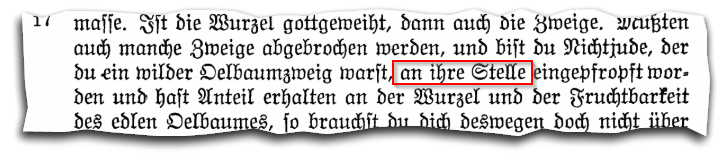
As in French, « an Ihre Stelle / a leur place » expresses a replacement, not a positioning aside / among.
This alteration, or overly far-reaching interpretation that goes beyond Scripture, suggests that the Church of the Gentiles (the elects) replaces the chosen nation, all Jews (including the first few thousand Jewish believers), and that the election of the Jewish nation (as a nation, not to be confused with the individual election of believers) is revoked, which the context of the passage rejects (cf. Romans 11:18-23), as well as Romans 11:28. This alteration is a stepping stone toward replacement theology.
In the following versions the Greek is not translated literally.
… and if you, who were a wild olive tree, have been grafted at their place, …
in french language, this expression means « instead of »
- LSG 1910
- NEG79
- Colombe
- Ostervald
- Synodale
- Martin
- Living Word
- NBS
- Crampon 1923
- NT Stappfer 1889
- Eugène Arnaud 1891
I was greatly surprised that a majority of reputable French protestant translations are not literal here. Paul’s letter has been distorted in french language.
Among them
Some modern translations adhere to the Greek here; among them, we note:
- Darby,
- NT: La Bonne Semence
- Louis Segond 21
- la Bible du Semeur
- Bible de Jérusalem
- La Bible Juive complète de David Stern
- La TOB
- Parole de Vie
- La Bible: Traduction Officielle Liturgique (2013)
- La Bible Bayard Médiapaul
- Chouraqui: ( … grafted on them … )
… and a few older versions as well. - Sacy 1701,
- Grande Bible de Tour 1866,
- Fillion 1904
- Traduction de la Vulgate, par Nic. Legros 1739
- Traduction de la Vulgate, par le R. P. de Carrières 1835
- La Vulgate
… and if you, who were a wild olive tree, have been grafted in among them,… / you have been grafted among the remaining branches
Undecided translations
- Bible de Genève 1588
… You were drafted in the place … - Pirot-Clamer 1949
sidesteps the problem by removing a portion of the verse:
If some of the branches were cut off and if you, a wild olive tree, were grafted in and became a beneficiary of the sap supplied by the root of the olive tree
Other Languages
German and English Bible translations are virtually unanimous and faithful to the Greek in this verse. Even a feminist German Bible, which is not literal, is correct here.
The Romanian translation is not; what are the reasons for this, and what is the impact? We will never really know. But the Orthodox and Catholic Churches in Romania, for example, persecuted even believers of Jewish origin ( Messianic Jews), just like non-believing Jews, during the Nazi period.
Why using literal translations?
We know that it is to the Jewish people that God’s oracles were entrusted (Romans 3:2)—the Law and the Prophets, but also the New Testament. The Messiah born of this people said, « Salvation comes from the Jews »—a shocking but true statement. We will not delve further into this controversy, but simply into the issue of the translation of this verse.
A translation error can negatively influence our beliefs, and our beliefs unfortunately influence our translations, which should never be the case in a literal translation. It is a vicious cycle. Eventually, our beliefs will also influence our actions.
Recommended reading:
From Pastor Richard Wurmbrand, a Romanian Jewish pastor: « Jewish Street ».

Notes:
- The released German-to-English translation of this NT by Greber writes: in their place. This was not the correct translation (An Ihre Stelle differs from In Ihre Stelle) : This English rendering is more ambiguous. It can also mean in their same location. This might explain why the Jehovah Witnesses translation remained faithful to the Greek here, whereas in some instances it aligns with Greber’s NT.